

01/03/2022
By: WO1 Jason Jackson, Regimental Sergeant Major, 1st/19th Battalion, the Royal New South Wales Regiment
Located in the high desert of California, near the remote desert oasis of Twentynine Palms, is the United States Marine Corps’ (USMC) premier combat training facility, the Marine Corps Air Ground Combat Centre (MCAGCC). Whilst the facility is home to a number of Units, there is one organisation, with extremely talented and experienced men and woman who are proudly referred to as “Coyotes.” Living amongst these Coyotes is one Dingo, the Australian Infantry Warrant Officer on the Personnel Exchange Program, embedded within the heart of the USMC. That Unit—the Tactical Training and Exercise Control Group (TTECG).
I was recently both honoured and privileged to complete a posting as part of the Personnel Exchange Program, spending two years as the Dingo within TTECG. These Coyotes, and the Dingo, form the basis of the combat instructor group, operating within their Military Occupational Speciality (MOS), or Corps function. I was very fortunate to work within the Manoeuvre Cell with an opportunity to conduct combined arms live-fire training in both rural and complex terrain, during mounted, dismounted and air assault operations. This brief overview of the TTECG will provide an outline of some of the functions they facilitate for the USMC.
TTECG designs, enables and oversees the Integrated Training Exercises (ITX) as a service level training exercise (SLTE) for the Marine Air Ground Task Force (MAGTF). This sustains and evolves live-fire and manoeuvre combined arms Tactics Techniques and Procedures (TTPs), simulates combat conditions that improve the rapid decision-making cycle, and integrates emergent friendly and threat capabilities in order to improve the MAGTF’s ability to adapt and accomplish missions across the full range of military operations.
There are a number of events within the SLTE in which TTECG provides training and assessment, based on evaluated training & readiness (T&R) events, associated with MAGTF operations, being the Integrated Training Exercise (ITX), Adversary Force Exercise (AFX) and the MAGTF Warfighting Exercise (MWX).
Integrated Training Exercise (ITX). The ITX is a combined arms live-fire and manoeuvre exercise designed to meet training standards supporting T&R events. It is 28 training day event, all live-fire, working from Platoon through to Battalion size events, all combined arms. Adversary Force Exercise (AFX). The AFX is a dynamic exercise that includes both Force on Force (FoF) and combined arms live-fire and manoeuvre training. The AFX consists of four stages: unit level training (ULT), collective unit training, MAGTF Warfighting Exercise (MWX) (FoF) participation, and live-fire training. Depending on the size of the force in training, AFX will typically last 14 training days.
MAGTF Warfighting Exercise (MWX). MWX is a FoF exercise designed to challenge the MAGTF against a peer adversary in a free-play environment. The MWX is a seven day (five in the field) blank fire field training exercise. The MWX is a similar exercise to the Combat Training Centre (CTC) Warfighter Exercise (WFX), but on a much larger scale and completely free play. At any one time, the MWX will see three Infantry Battle Groups, complete with all enabling assets, including a Logistic Combat Element (LCE) and an Aviation Combat Element (ACE) in support. Once a year, a Marine Division will be exercised during the conduct of the MWX.
There are a number of live-fire ranges that form the combined arms live-fire and manoeuvre training events within the ITX and AFX:
R410A – Platoon Supported Attack is a deliberate attack on a fortified position executed by a reinforced rifle platoon, conducting deliberate offensive operations and integrating 60mm mortars, medium machine guns, rockets, and breaching actions against a fortified position by both day and night. The primary location for the conduct of the Platoon Supported Attack is on MCAGCC Range 410A.
R400 – Company Supported Attack is a deliberate attack on a fortified position by a reinforced rifle company, conducting deliberate offensive operations and integrating heavy machine guns, 81mm mortars, scout snipers and combat engineers against a fortified position. The primary location for the conduct of Company Supported Attack is on MCAGCC Range 400.
R230 – Company Supported Attack is a deliberate attack on complex urban terrain by a reinforced rifle company, conducting offensive operations in an urban environment while integrating scout snipers, combat engineers and heavy machine guns. The primary location for the conduct of Company Supported Attack is on MCAGCC Range 230.
Regimental Air Assault Course (RAAC) – forms an Air Assault Task Force (AATF) to seize an objective, conduct a dismounted defense, combined with air assault contingency planning in an enemy mechanized environment.
Battalion Distributed Operations Course (BDOC) – The BDOC is a live-fire combined arms event for the reinforced infantry battalion exercising combined arms manoeuvre lanes, supported by artillery, aviation and logistic support operating over four days in offensive and defensive operations. The BDOC provides the artillery battery the opportunity to conduct battery level tactical fire direction in support of manoeuvre elements in both offensive and defensive operations. The BDOC provides the LCE with the opportunity to establish a Rear Area Operations Centre (RAOC) and coordinate rear area security, the opportunity to establish a Combat Service Support Area (CSSA) in support of resupply operations as well as medical treatment and evacuation. The BDOC provides the ACE with the opportunity to provide Air Reconnaissance (AR), Offensive Air Support (OAS), Assault Support, control of aircraft and missiles, and forward arming and refuelling point (FARP) operations.
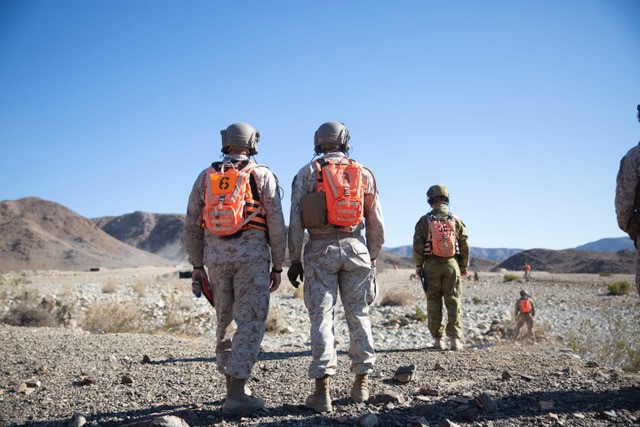
The Coyote has three very important and distinct functions when conducting any of these activities. In priority order, they include: to teach, coach and mentor; bring the range to life; and to provide a safety backstop. Live-fire combined arms ranges and providing a safety backstop is third in order of priority… The safety requirements to run any one of these ranges is lower than those required by the Australian Army, yet the ranges themselves are inherently safe. Like Combined Arms Training Centre (CATC) range architecture, the overarching safety responsibility of the TTECG ranges still rests with an OIC… but the diffuse and layered approach afforded by the multiple “Coyotes” across specialisations and MOS afford an exceptional freedom of action and realism.
Coyotes must undergo a comprehensive qualification process prior to appointment. Part of this process includes understanding the unique calls made on radios that inform all Coyotes of pending actions on the ranges. Another key component is understanding how to clear fires, whether it be small arms, mortars, artillery or even aviation fires. A Coyote can very quickly deny any fires on a range if they identify a safety issue.
It is important to note that the USMC conduct their ranges in a similar construct to the Australian Army, with similar safety deviations and education leading up to conduct of ranges. TTECG have a series of permanent manoeuvre ranges established and a robust safety policy and flexible safety mechanisms, allowing live-fire combined arms training to be taken to that next level. This allows ground force commanders, at all levels, the opportunity to co-ordinate, synchronise all effects and close on an objective utilising all enabling assets. Put simply, there are no off-set targets on any TTECG range; commanders will coordinate effects onto the same objective that the Infantry Marines will physically clear, either mounted or dismounted.
My time as the Dingo, living and working with the Coyotes, was an extremely rewarding period. TTECG taught me a lot through discussion, conduct, example and exposure. As an Army in Motion, and while still innovating in the manner our unique culture and operating environment demands, building to accelerated warfare, we can nonetheless learn from other organisations like the USMC, who are contending with their own image of future warfare. I highly recommend that any RAInf Warrant Officer Class Two, post-RAR CSM appointment, consider applying for any one of a number of overseas appointments; In particular, becoming the Australian Dingo at the Tactical Training and Exercise Control Group.